
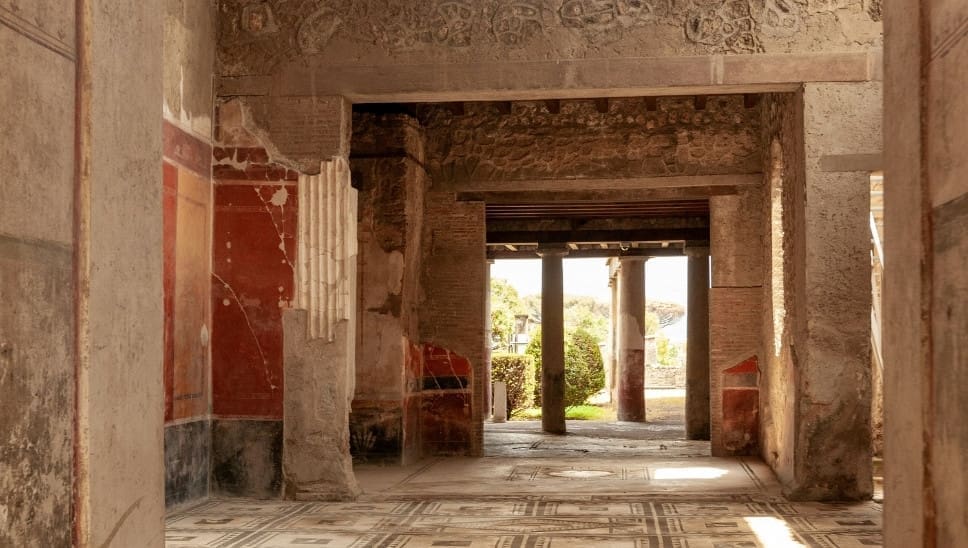
Unearthing Ancient Roman Secrets
Among the most visited archaeological sites in the world, the Pompeii ruins welcomed over four million visitors in 2024.
This record confirms its timeless allure and its role as a vivid observatory of life in the Roman Empire.
The eruption of Vesuvius in 79 AD buried the town under lava and ash, preserving it for centuries.
New discoveries in Pompeii continue to reveal fragments of that distant world, keeping curiosity alive among history lovers.
Visiting Pompeii is a once-in-a-lifetime experience, yet constant findings make it worth exploring again and again.
Pompeii Discoveries: Egyptian-Inspired Finds in a Roman Kitchen
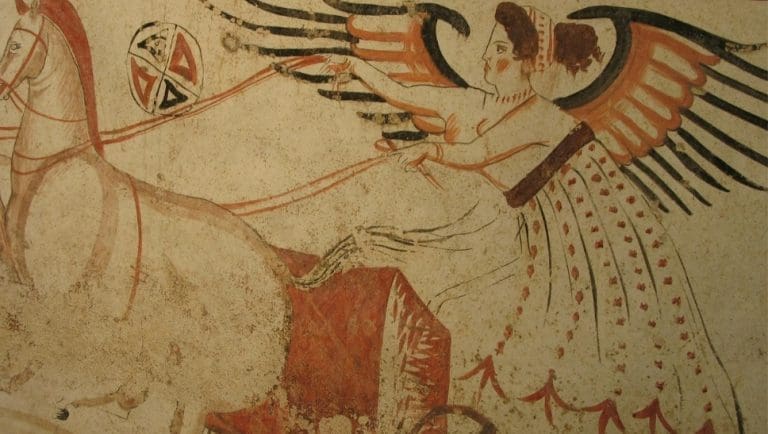
Recent Pompeii discoveries in the Regio V area have revealed new details about daily life and cultural exchange in the ancient city. Excavations near the Thermopolium, an ancient street-food tavern, uncovered a finely decorated glass situla made in Alexandria, Egypt. Originally an ornamental garden piece, it was reused here as a kitchen vessel, illustrating both practicality and artistic taste. The site also includes service rooms, cooking tools, wine amphorae from across the Mediterranean, and a small upstairs apartment with vivid Fourth Style frescoes. These findings highlight Pompeii’s vibrant mix of domestic life, trade, and spiritual influences — where Egyptian motifs and Roman traditions coexisted even in humble settings.
Treasures Emerging from the Ashes
In January 2025, ongoing excavations unveiled a large private bathhouse within a residence explored over the last two years.
This spa-like complex, with hot, warm, and cold rooms, ranks among the most impressive Pompeii discoveries so far.
The cold plunge pool stands out with red columns and frescoes of athletes.
Nearby, a changing room features red walls, a mosaic floor, and stone benches for about thirty people.
Its proximity to a banquet hall suggests the Roman tradition of bathing before grand feasts.
The find is among the most fascinating new discoveries in Pompeii.
Pompeii discoveries reveal details of Roman daily life activities
The rarity of private baths indicates the owner’s elite status.
Lavish banquets combined with relaxation reinforced social prestige and power.
The domus likely functioned as a stage for its owner — a blend of public ambition and private luxury.
These new discoveries in Pompeii shed light on Roman daily life in every detail.
Pompeii discoveries: just like a scene described by Petronio
The Satyricon, a Latin work attributed to Petronius, echoes this same lifestyle.
Trimalchio, its wealthy protagonist, hosts an extravagant banquet after visiting a balneum (bathhouse).
Though set in an unspecified Campanian city, the tale mirrors the customs of Pompeii before 79 AD and
highlights the excesses of newly rich citizens seeking prestige through luxury rather than culture.
Pompeii discoveries vividly illustrate these social dynamics, unchanged through centuries of human behavior.
The Sacrarium: Nostalgia for a Lost World
Within the same excavation, in 2024, archaeologists unearthed another marvel — a possible Sacrarium beside the bathhouse.
Its blue walls, a rare color in Pompeii’s Fourth Style, depict female figures symbolizing the seasons and rural allegories.
For the urban elite, such scenes expressed nostalgia for a lost pastoral world, idealized and unattainable.
The room likely held sacred objects and hosted rituals.
Finds include fifteen amphorae, bronze vessels, oil lamps, and oyster shells reused in plaster and mortar.
New Discoveries in Pompeii: The Black Banquet Hall
A few months earlier, excavations had revealed a splendid banquet hall with black walls and Trojan War frescoes.
Now fully accessible, the room radiates elegance and grandeur.
It was a space for conversation, feasting, and intellectual exchange.
Its Third Style frescoes, mythological subjects, and refined mosaics confirmed the owners’ distinguished social rank.
The new discoveries in Pompeii are related to the huge Pompeii excavation of Regius IX
All these new discoveries in Pompeii belong to the same area — Regio IX.
This sector, once inaccessible, now offers immense potential for archaeological insight.
Recent work uncovered two additional domus, first built in the Samnite period and repurposed in the 1st century AD.
One became a fullonica, a Roman laundry with vats for washing and dyeing clothes.
The other, a bakery, included an oven, milling areas, and spaces for preparing goods for city markets.
Pompeii discoveries: How much of Pompeii was excavated?
Tourists often ask: “How much of Pompeii has been excavated?”
Early attempts date back to Emperor Alexander Severus, but systematic excavations began under Charles of Bourbon in 1738.
Today, about 49 of the 66 hectares have been explored, leaving one third still buried.
Since 2012, the Great Pompeii Project has worked to preserve the exposed ruins.
Its focus includes wall stabilization, restoration of frescoes, and protection from weather, erosion, and theft.
In the end, Pompeii discoveries are not random miracles but the result of deliberate, patient preservation.
Archaeology here is a race against time — one that continues to reveal, not exhaust, the city’s eternal mystery.
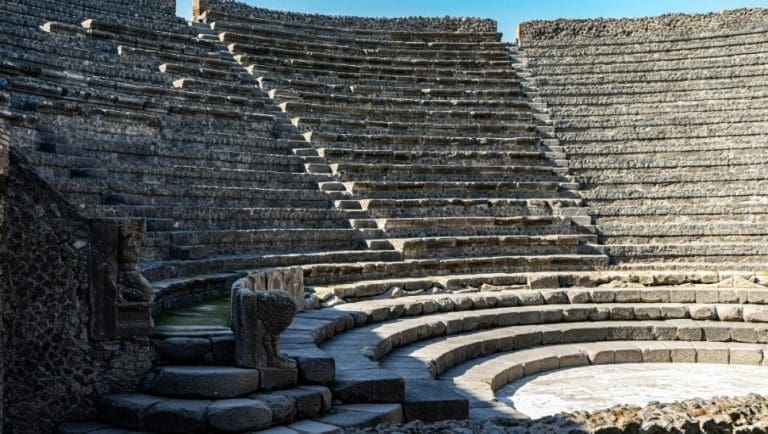
#*The pictures shown are representative of the Pompeii Archaeological Site. For images of the latest findings, please refer to: Finestre sull’arte and BBC article
jELSftFRFcirBTIhaLpKwUP