
With its immortal beauty, sumptuous blue skies over millenary majestic architecture, Rome is a unique city. Its timeless charm and the magic that colors its atmosphere conceal an incredible variety of facts and curiosities, layered over time, which fuel the myth of this ‘Eternal City,’ as we Italians are accustomed to calling it, and which is absolutely worth knowing. In this article, you can read 10 fun facts about Rome that you probably didn’t know.
Did you know Rome is the city with the most fountains in the world?
With around 2,500 fountains, Rome holds the highest number of fountains in the world. In ancient times people called it the “Queen of Waters” thanks to its abundant springs and to the 11 aqueducts built over just five centuries—extraordinary works that still showcase the engineering mastery of the era. Many of the city’s most iconic fountains, including the famous Trevi Fountain, serve as the visible and spectacular endpoints of refined underground systems.
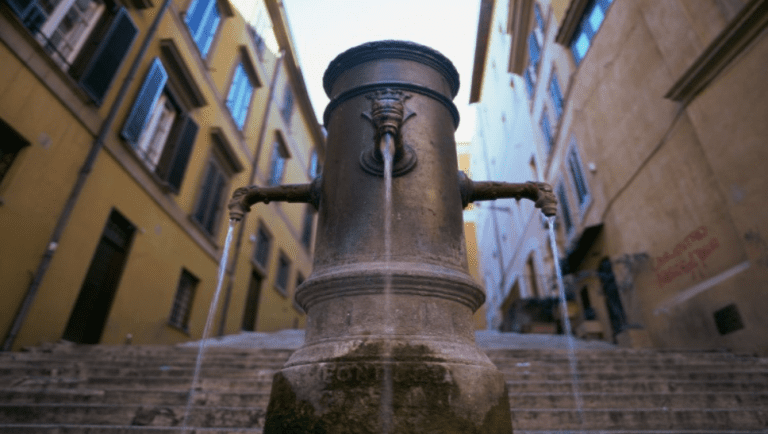
Yet Rome’s most distinctive fountains, aside from its monumental masterpieces, are the “nasoni”: cylindrical fountains with a long, curved spout shaped like a large nose. The first nasoni appeared in the 19th century and featured three dragon-shaped spouts. You can still admire them in Via della Cordonata, Piazza della Rotonda, and Via San Teodoro.
If you want to pinpoint every nasone in the city, download the Waidy App and explore Rome by following the drops of its ancient water paths. Keep reading to discover fun facts about Rome you might not know.
Fun facts about Rome: Did you ever hear about naval battles in the Colosseum?
As the most iconic symbol of Roman civilization, the Colosseum is famous for gladiatorial combats, but it also staged naumachiae—mock naval battles that remain one of Rome’s most surprising facts. Ancient sources describe a complex system of pipes and channels that flooded the arena floor, creating a shallow basin where flat-bottomed ships could maneuver.
These spectacles often recreated famous sea battles and involved condemned prisoners or captives forced to fight, sometimes to the death. Emperor Titus inaugurated the Colosseum in 80 AD with a grand naumachia, and Emperor Domitian organized others during his reign.
Everything changed when engineers built the hypogeum, the intricate underground network of tunnels, cages, and machinery beneath the arena. Its structure made any future flooding unfeasible, and naumachiae disappeared from the Colosseum’s program of spectacles.
Fun facts about Rome: What happens to the coins that are thrown into the Trevi Fountain?
The custom of making a wish and tossing a coin in Italy has its most iconic stage in the Trevi Fountain. In this majestic late Baroque masterpiece—famous from La Dolce Vita and To Rome with Love—hundreds of visitors entrust their hopes to a single gesture every day. Tradition says you must throw the coin with your right hand over your left shoulder, eyes closed and back to the fountain, to guarantee a future return to Rome.
But what happens to all those coins? At least twice a week, early in the morning, staff use powerful suction pumps to clear the basin and collect coins from all over the world. The daily total reaches roughly three thousand euros, for an annual amount of about 1.5 million euros. The city donates this entire sum to Caritas, a Catholic charity that supports people in need.
Among Rome’s many curiosities, this one likely creates the most good.
Fun Facts about Rome: Did you know that cats in Rome are protected by law?
When you wander through central Rome, you often find cats curled up beside major monuments, ancient excavations, and scattered ruins. This bond goes back to the imperial age, when Romans considered felines sacred and believed their pact with them continued into the afterlife. About ten years ago, archaeologists uncovered remains in one of the oldest colonies—Trajan’s Market—that reveal a community of cats already living there around 400 AD.
Today, the colonies of Largo Argentina, the Pyramid, and the Colosseum form true feline dynasties. Romans care so deeply for them that the city designated these areas as protected zones. Many locals say the bond endures because cats share the same sly, clever nature that defines Roman spirit itself. This mutual resemblance seems to nourish an affection strong enough to last for millennia.
A surprisingly sweet curiosity, isn’t it?
Fun facts about Rome: What is the secret to the durability of Roman structures?
Rome stands out for the charm of a millennia-old history that constantly interacts with the energy of a modern capital—one that still preserves a deeply human spirit. This uniqueness stems from the city’s majestic ancient structures, which rise with the same strength as History itself. But what gives Roman architecture such extraordinary longevity?
Roman concrete hides the secret: it can repair itself. Ancient builders created it by firing quicklime at extremely high temperatures and mixing it with volcanic ash. This process produced fragile lime clasts that, once in contact with water, triggered a self-healing reaction capable of sealing cracks and restoring cohesion.
Many ancient writers praised the quality of Roman engineering, but even they probably never imagined that their bridges, temples, aqueducts, houses, and amphitheaters would endure for thousands of years. Their legacy continues to astonish us and inspires ongoing research into innovative materials in modern engineering.
Fun facts about Rome: Did you know the mouth of the Truth bites liars?
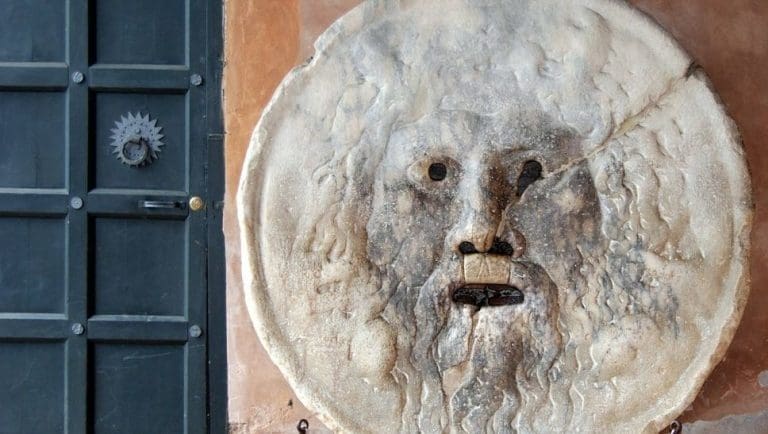
Made famous by the movie “Roman Holiday” with Audrey Hepburn and Gregory Peck, the Bocca della Verità (Mouth of Truth) is one of the most well-known symbols of the city of Rome. Located in the square of the same name and placed on the front facade of the Basilica of Santa Maria in Cosmedin, perhaps not everyone knows that the ancient marble mask was originally a Roman-era manhole cover, built during the reign of Tarquinius Superbus, the last of the seven Kings of Rome, who created the Cloaca Maxima, an imposing drainage conduit. According to legend, the Mouth of Truth does not like liars and is said to bite anyone who doesn’t tell the truth while inserting their hand into its merciless mouth. In the Middle Ages, jealous husbands brought their wives to the Mouth of Truth to confirm their fidelity. And you? Have you already challenged the judgment of the Mouth of Truth?
Fun facts about Rome: Did you know that the founding of Rome is linked to a She-wolf?
The origins of Rome lie in myth. Legend tells that Ascanius, son of the Trojan hero Aeneas, founded Alba Longa on the right bank of the Tiber. Among his descendants, two brothers—Numitor and Amulius—competed for the throne. Amulius seized power, expelled Numitor, and forced Numitor’s daughter, Rhea Silvia, to live as a Vestal Virgin, hoping to prevent any heirs who might challenge him.
Mars, however, fell in love with Rhea Silvia and fathered twin boys: Romulus and Remus. Amulius ordered their death, but the guards, moved by pity, placed the newborns in a basket and set them adrift on the Tiber. The river carried them to a bank where a she-wolf, drawn by their cries, nursed them in her den on the Palatine Hill. A shepherd and his wife later raised them.
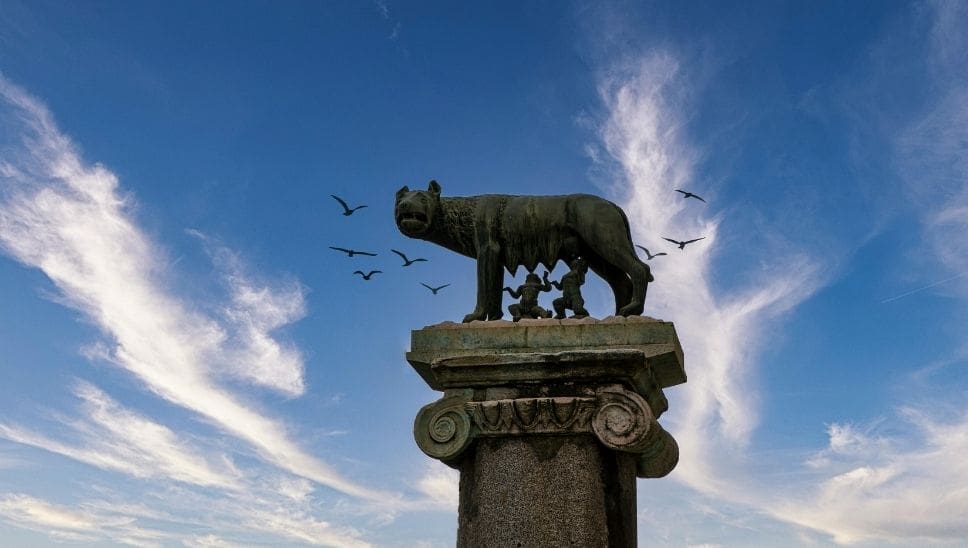
As adults, the twins killed Amulius, restored Alba Longa to Numitor, and founded a new settlement on the Palatine—the place where the she-wolf had saved them. The Capitoline Wolf, today in the Capitoline Museums, commemorates this legendary beginning.
Fun facts about Rome: Did you ever hear about Roman Pasquinades?
The character of the people of Rome is something astonishing. You will hardly find elsewhere that mix of vivacity, warmth, and sarcasm that characterizes their lively social interactions. Even people from other regions of Italy are sometimes unable to grasp the fierce humor of Romans, mistaking their epithets for insults. But the fierce Roman satire has its roots in the past.
Roman pasquinades are satirical compositions, in verse or prose, that were anonymously affixed to the talking statues of Rome, particularly the statue of Pasquino, to express criticism of those in power or public figures. These messages, often short and sharp, were a way for the people to express their dissent and to make fun of the powerful.
Over the centuries, pasquinades have become a symbol of Roman satire and the people’s ability to express their voice anonymously and, at times, even with a touch of irony and audacity.
Fun facts about Rome: Did you know that the ancient Romans built the first covered shopping mall in history?
The Markets of Trajan, located in the heart of ancient Rome, stand as a remarkable testament to Roman engineering and urban planning. Constructed in the early 2nd century AD under Emperor Trajan, this sprawling complex wasn’t just a marketplace; it was arguably the first covered shopping mall in history. Designed by Apollodorus of Damascus, the multi-level structure housed over 150 shops, offices, and even apartments. Here, Romans could find everything from food and wine to clothing and spices. The sophisticated design included vaulted ceilings, strategically placed windows for light, and well-organized spaces, making it a bustling hub of commerce and social life. More than just a place to buy goods, Trajan’s Markets represented a novel approach to consolidating trade and services within a grand architectural framework, influencing urban development for centuries to come.
Fun facts about Rome: Did you know that Vatican City is the world’s smallest independent state?
In the heart of Rome, Vatican City rises as the world’s smallest independent state, a unique enclave shaped by centuries of history. Its story begins in the 4th century AD, when builders erected the first basilica above the tomb of Saint Peter. Over time, the papacy expanded its temporal power and created the Papal States, which controlled much of the Italian peninsula until the late 19th century, when the new Kingdom of Italy absorbed most of those territories.
The modern Vatican took form in 1929 with the Lateran Treaty, an agreement between the Kingdom of Italy and the Holy See that defined the Vatican as a sovereign state and guaranteed its independence and neutrality. This autonomy allows the Holy See to govern without political interference and to guide the Catholic world freely.
Today Vatican City operates with its own legal system, postal service, euro-based currency agreement, media, and security corps—the Pontifical Swiss Guard—reinforcing its singular role on the global stage.
0 Comment